|
Disadvantages of Dental Composites
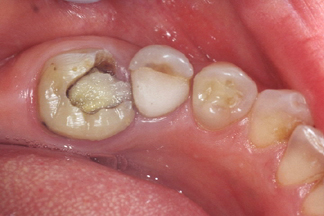 Failed Composite Filling The disadvantages of dental composites are many, and though they have been somewhat improved over the last few years, they still leave a lot to be desired. Composites are generally made from synthetic resins which are usually petroleum-based. They are softer than natural tooth material, and even though light-curing helps to harden them, they still may fail. This is usually because the light curing must be done in exact, tiny increments of two to three millimeters at a time. If this curing is not done exactly right, the composite filling will be too soft, and may shrink and fail. Shrinkage is another common problem with these types of fillings, especially during light curing. Although the newer types have lower incidents of thermal shrinkage, and adhere better to cavity walls, unless they are meticulously placed with great attention to detail, they will fail. The adhesion is dependent upon keeping the entire area perfectly dry, using the proper amount of compound, using the correct curing procedure, and if the entire filling is not cured properly, the composite will remain partially soft. This un-polymerized material may then leak into the tooth nerve, causing irritation or even nerve death. Composites used in posterior restorations (back teeth, or molars) are more prone to failure because of the immense forces placed upon them during chewing. As is described on the Preserving Tooth Structure page, these forces are distributed evenly to the core of the tooth, when the tooth is intact. Composites do not have the ability to transfer these forces efficiently, and as a result, are prone to failure. Posterior composite restorations have been shown to last for a significantly shorter period of time than amalgam fillings. In a best-case scenario, composite fillings have a life expectancy of from two to ten years, on average. They are technique-sensitive, meaning that an exact, meticulous protocol must be followed--a protocol that is time consuming for the patient and the practitioner. These restorations may also leak, and allow bacteria, viruses, toxins, and infectious agents into the interior of the tooth, and eventually the bloodstream. While they may look aesthetically pleasing at first, eventually they do deteriorate and discolor. Composites are definitely not a fool-proof, permanent method of tooth restorations. Return from "Disadvantages of Dental Composites" to Home Page |

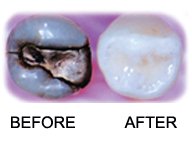
A better, more comfortable and healthier way to fill teeth!
CLICK HERE to find out about our Laser Nerve Treatment, a way to avoid root canals!