|
Alternatives to Dental Crowns
In our practice of modern dentistry, we now offer effective, strong, and proven alternatives to dental crowns. In conventional dentistry, if a tooth is missing a lot of structure due to a large, failed filling or a large amount of decay, the dentist would recommend a crown. The conventional mixed-metal crown requires even more healthy, viable tooth structure to be ground down--in fact, the tooth is generally reduced to almost 1/3 of its normal size--in order to provide enough adhesive surface for the crown to be cemented to. This is because traditional crown cement has poor adhesive qualities, and large amounts of it must be used in order to keep the metal crown in place, and it needs large amounts of surface area to hang on to. Crown cement for metal crowns has other flaws. It is subject to leaking, and the acidity of saliva eventually erodes the cement, allowing bacteria, toxins, and infectious agents to leak under the crown, possibly causing new decay in the treated tooth. This new decay cannot be detected because the metal crown blocks any X-Rays that would reveal evidence of decay. The mixed-metal crowns have been found to cause a galvanic, or battery effect in the mouth when mixed with saliva. This causes measurable voltages to be generated in the oral area, which have been shown to cause electromagnetic interference with normal brainwave patterns. Also, when the cement leaks, the saliva mixing with the mixed-metal crown can cause electrolysis and corrosion underneath the crown, which will also cause it to eventually fail. In our practice, we have removed countless failed crowns where we have seen this corrosion and erosion of the remaining tooth structure. Fortunately, there are safe, biocompatible alternatives to dental crowns that don't have any of the above-mentioned problems. They are called tooth inlays, or onlays, and they can replace the missing, damaged tooth structure. These inlays or onlays are made of toothlike materials, and are bonded to the teeth using lasers, actually becoming a part of the tooth and restoring it to its original strength, in many cases. When a tooth has been treated in this manner, it has a much better chance of never needing any further treatment later in life, with the added benefit of no intra-oral galvanic, battery effects being produced. Additionally, there is no cement to leak or be washed away by the acidity in saliva. These alternatives to dental crowns are safe, non-toxic, more biologically friendly and extremely more reliable than the conventional crown restorations that are traditionally done. However, it is important to note that sometimes the damage to a tooth structure may be so severe that the only viable, practical restoration is a crown. If that is necessary, we use non-toxic, non-metallic biocompatible porcelain crowns that are very strong and very natural looking. These crowns are bonded to the remaining tooth structure with a bonding compound that is fused with a laser, which is much stronger and more effective than the common crown cement. Also, if you have an existing mixed-metal or non-biocompatible crown that you are concerned about, we can replace it with a biologically-friendly, laser-bonded porcelain crown. To find out more about this subject, or to see if you are a candidate for inlay/onlay restorations, you may CONTACT US for more information. |
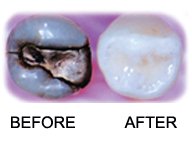
A better, more comfortable and healthier way to fill teeth!
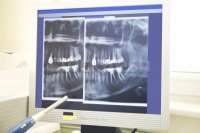
CLICK HERE to find out about our Laser Nerve Treatment, a way to avoid root canals!